Synopsis:
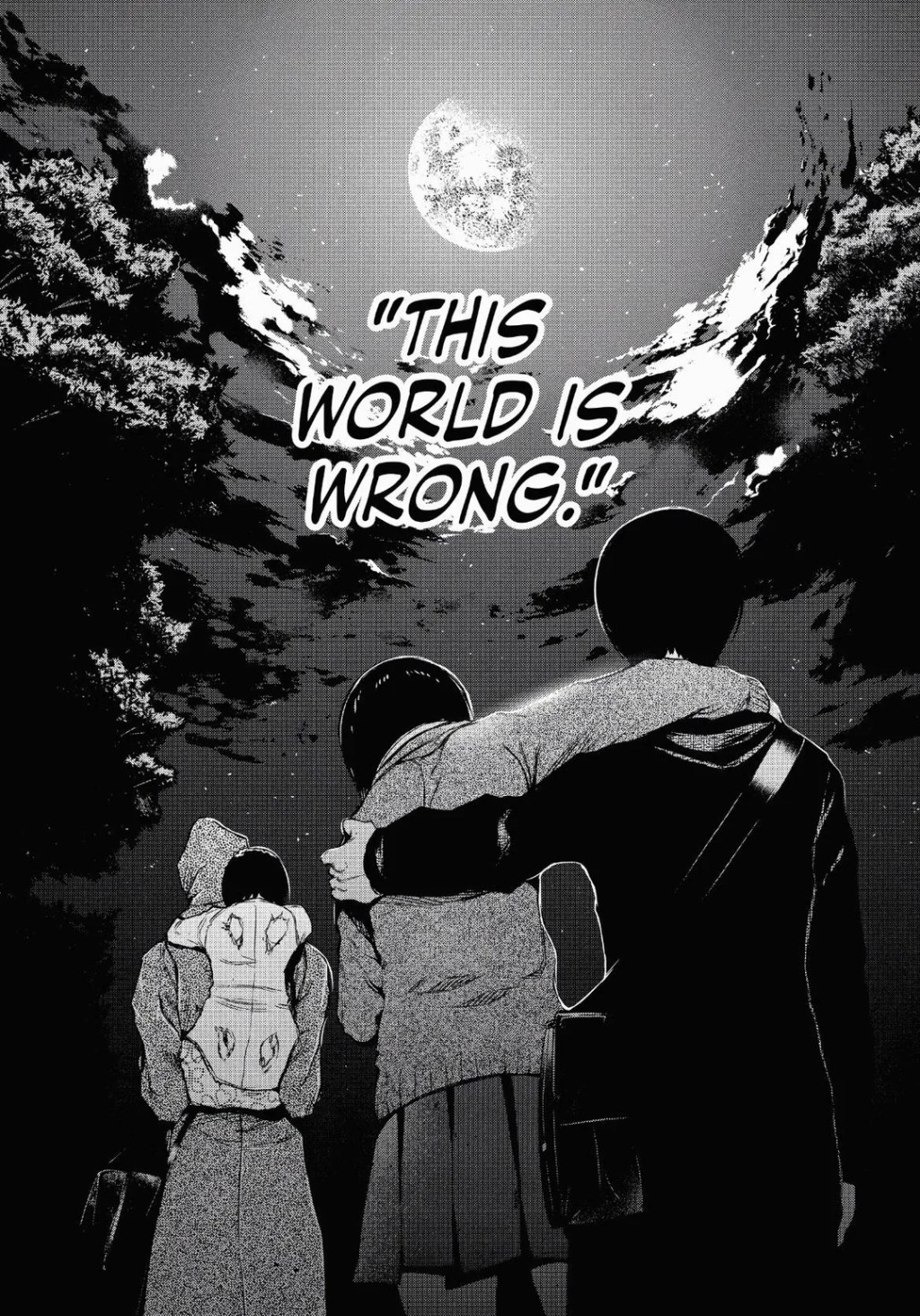
Tokyo Ghoul is a manga series created by renowned Japanese author Sui Ishida. It began publication in September 2011, finished its original run in September 2014, and was followed up by its direct sequel, Tokyo Ghoul:re which began serialisation immediately in October 2014, and ended in July 2018. Set in an alternative version of modern-day Tokyo, Japan, the story follows several narratives, split between the ghouls, flesh-eating humanoid creatures with superhuman strength and additional organic weapons known as Kagune, and humans, who use Quinques made from the Kagune of ghouls in order to combat them in an organisation known as the CCG (Commission of Counter-Ghoul). The main protagonist, Ken Kaneki, is a teenage human who, through a short romantic engagement with the ghoul Rize, is nearly killed, and winds up saved by the Frankenstein-inspired Doctor Kano, who turns him into a half-human, half-ghoul hybrid (known as a one-eyed ghoul, since full-ghouls have Kakugan, red and black eyes which change their regular eye colours when they use their Kagune, whilst half-ghouls only have one Kakugan). Rize’s organs are transplanted into Kaneki, resulting in him having the same craving for human flesh and inability to consume regular food (despite his attempts). So ensues the saga of Ken Kaneki, a man endlessly attempting to lead a moral existence whilst living with indefatigable compulsions towards immoral acts.
The meaningless line:
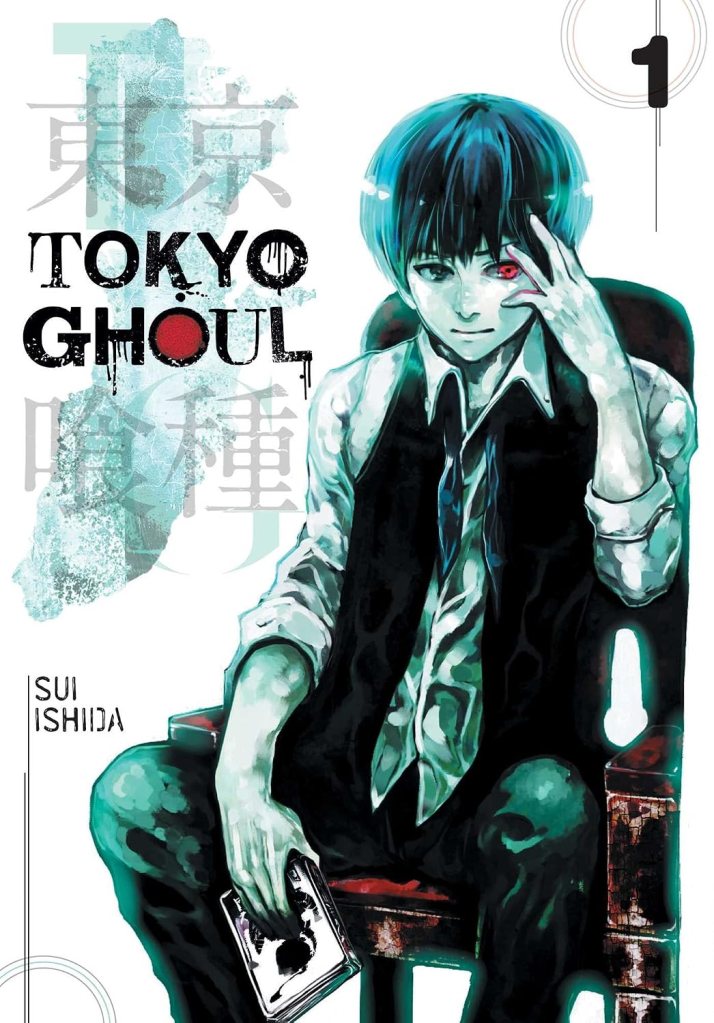
Tokyo ghoul Vol.1 cover, credit: Viz Media
Whilst one may naturally be compelled to root for humanity in any such scenario as ‘mankind vs. man-eaters’, Ishida immediately clarifies the lack of substantial distinction between ghouls and humans from a moral sense. Some of the very first ghouls that readers are introduced to are the like of Mr. Yoshimura, a benevolent cafe owner who goes out of his way to help ghouls who do not want to feed on live humans. It is made clear he has many sins weighing him down, but his constant desire to atone and live a reasonable life clearly shows the audience the presence of kind-hearted ghouls, destroying the illusion that they are innately monstrous. We are also introduced to several ghoul children, such as the orphaned Touka Kirishima and Hinami Fueguchi, who serve to portray the classic dilemma of the ‘sins of the father’. To be born a ghoul is their original sin, yet whilst humans can be absolved, ghouls cannot, regardless of their attempts to minimise their exploitation. In showing this inequality, Ishida creates empathy for ghouls, especially as they are entirely sentient beings aware of their innately amoral existence: “It doesn’t matter if a murderer like me dies.” (Tokyo Ghoul, Chapter 18).
Compare this to the first impression we get of the highly sanctimonious CCG investigators, who use heavy religious imagery to showcase their own moral superiority. Referred to as doves by the ghouls, they are immediately associated with the holy spirit of Christianity. Further yet, one of the first two CCG investigators we meet is Kotaro Amon, a character who constantly carries a cross on his neck. The other character we meet is the ghoulish Kureo Mado, a sadistic degenerate who is notoriously obsessed with Quinques. His visceral and grotesque behaviour often breaks the ‘code’ of the CCG to inflict minimal pain in their acts, and yet, nothing is done to him; as a matter of fact, he is in a high-ranking position within the CCG, showing readers the corrupt and rotten underbelly of this ‘sacred’ organisation. The humanisation of ghouls and the oxymoronic sanctification and demonisation of the CCG serves to immediately deconstruct the natural moral line readers may draw and reminds them of something that becomes pivotal to the story later: humans are just as exploitative as ghouls, they simply exploit others through means they deign as systemic justice.
You may wonder why this amorality is so important to establish as early as the second volume of the series. To that, I reply, what device are you reading this on? How many devices do you own inside your home? Seventy percent of the world’s cobalt supply comes from the Democratic Republic of Congo. The battery you use to view this is caked in the blood, sweat and tears of child slaves. Every convenience you have today is the result of someone else’s suffering. It is utterly impossible for a contemporary human to exist in any first-world country without exploiting another person, somewhere else. You, yourself, are a ghoul. The deconstruction of the line points out that the line is entirely arbitrary. The only distinction between the ghouls and humans is that ghouls are more direct in their acts of exploitation. They still attempt to live normal lives in society, they’re virtually indistinguishable from humans, there is nothing but a superficial difference in strength which humans have long ago closed the gap on with technology like the Quinque, that also comes from exploitation.

Child labourers in congolese cobalt mines, credit: humanium.org
The conclusion to be drawn here is that the moral line is an ouroboric pursuit. In simpler societies, where cause and effect could be measured, deontological concepts of righteousness can be applied reasonably, but in a contemporary society, where every action has a global ripple effect, exploitation becomes a fact of life, making causing suffering a sub-conscious impulse. People who are equally evil to those they persecute deem themselves the superiors on arbitrary aesthetic principles, the ‘head’ eating its own ‘tail’, those deemed as uglier, lesser, amoral in their actions, in an endlessly self-destructive hierarchy. This is even presented in the finale of the series. Union between ghouls and humans does not come naturally, through the process of diplomacy or equal discussion, but rather through the presence of the “dragon orphans”, less intelligent life that can be placed lower on the social hierarchy than even the bestial and terrible ghouls. “Maybe a long time ago something like the dragon assault happened and created ghouls.” (Tokyo Ghoul:re, chapter 179) clearly shows this cyclical nature of othering and dehumanising for the sake of one’s own ascension in the moral hierarchy. There is no line of morality, there is only an ever-shifting scale of the good and contemptible which humans refer to as virtue. This is the major fallacy that occurs within all moralistic frameworks.
Ken Kaneki, The Rebis, And Transcending the Moralistic Framework:
In alchemy, the Rebis is a perfected being, “After one has gone through putrefaction and purification, separating opposing qualities, those qualities are united once more in what is sometimes described as the divine hermaphrodite—a reconciliation of spirit and matter, a being of both male and female qualities…” (Rebis: the Result of the Great Work in Alchemy). Kaneki’s great struggle, that which putrefies and purifies him repeatedly, is the conflict of his ghoulishness and humanity. He is defined by his anxious attachment, a result of the neglect he faced from his mother, which causes him to obsessively seek to protect both the ghouls and humans in his life, literally shifting personas and selves to fit into each group at different points in the story. Duality, as described by the hermaphroditic nature of the Rebis, is a constant motif throughout his character: his Kakugan and human eye, with both being covered by his eyepatch and ghoul mask respectively, his endlessly yin-and-yang shifting hair colour, the checkered black-and-white pattern that haunts his mind, and so on. He is the unwilling fusion of the righteous and immoral, not capable of being placed on either end of the scale, neither the head nor the tail. In this, he is alienated from both sides. This is both his torment and the reason why he is essentially a perfect lifeform; he is the product of “synthetically generated heterosis” (Tokyo Ghoul, Chapter 99), making him objectively stronger than most ghouls or humans. Despite his moral torment, he is the one and only person who can and does bridge the gap between ghouls and humans. His enlightened position allows him to empathise and understand the corruption within both factions, putting him in an elevated position where he sees the truth of their moralistic society, that ghouls are not truly awful, nor are humans truly virtuous. Unfortunately, his simple life of gradual understanding is cut short, when he is tortured horrifically after attempting and failing to rescue a group of ghouls captured by the Aogiri Tree. In this, he faces the absurd, the uncaring nature of existence, and at first submits to a form of philosophical suicide: “All the suffering in the world is born from an individual’s lack of ability.” He adopts this fallacious mantra to shut down the cruelty and injustice of the world, to avoid further confronting the absurdity of morality. If he didn’t, how else could he reconcile the agony he was put through with his own ‘virtuous’ life? He places the total responsibility of suffering on the individual, and faces the first of his many putrefactions, the completion of his first metamorphosis into Ken Kaneki, the ghoul, and the true beginning of his self-realisation.
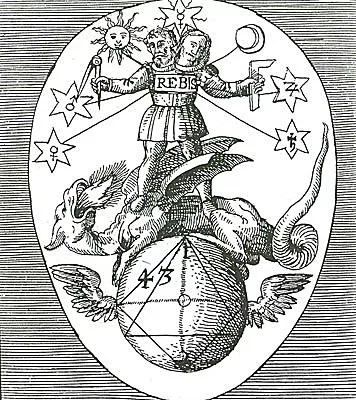
An illustration of the Rebis, credit:public domain.
It is no coincidence, then, that his final metamorphosis, in which he becomes truly free from binary morality, is also alchemical. He is transformed into ‘The Dragon’ by Furuta, after yet another torturous fight. “The dragon in alchemy represents the prime matter, as well as the third alchemical element: sulfur. The winged dragon suggests ascension, a merging of material and spiritual.” (Rebis: the Result of the Great Work in Alchemy) At this point, he is forced to face every persona he has used throughout the story, as well as his maternal hallucination of Rize, and finally comes to the realisation that he himself has not lived a moral life: he is faced with all of the people who died as a result of his actions, and confesses that all he truly wanted “was to be needed by someone…” (Tokyo Ghoul:re, chapter 159). He is deontologically corrupt. However, it is at this point that he is once again faced with the absurd, in that his life has been morally meaningless, and opts to make a completely different choice: rebellion. “I had happiness” (Tokyo Ghoul:re, chapter 159) He remarks and chooses to wade through a mental river of all his sins, pushing forward instead of creating another fallacious belief about the suffering off the world. This leads to one of the most iconic conclusions in all of manga history: “The world isn’t wrong, it just is.” (Tokyo Ghoul:re, chapter 176). In this moment, Ken Kaneki becomes the Rebis in its most purified state. Transcending ghouls and humans, transcending evil and good, transcending all binaries and dualities to become a single, pure, complete form. He rejects the moralistic framework that there must be good and evil and accepts his sins and virtues as a part of his whole self, rather than different, fragmented personas or voices.
The Path to a Joyful Existence:
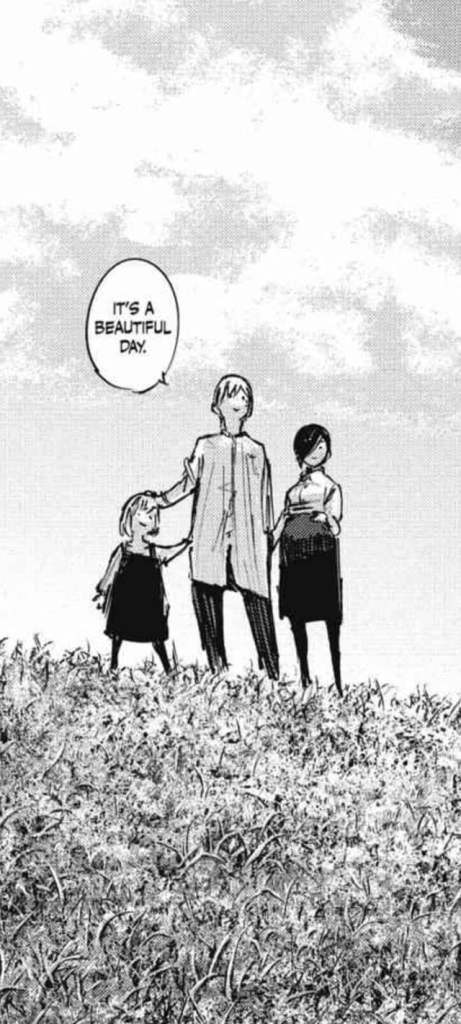
The world of Tokyo Ghoul is deeply reflective of our conflicting nature in the real world. We partake in the suffering of others but deem ourselves more just than murderers. Our expenditures line the pockets of rapists, yet we deem ourselves righteous for condemning them with our words. Some may say that it is simply impossible to avoid these acts. They are right; brands like Nestlé have silent tendrils spread across the world of food. You most certainly fund them even if you avoid their branded products, and it is completely impossible to live without a computer or telephone in any contemporary setting. How can you get a job or communicate long-distance and organize? Yet does that change the intrinsic negative weight of your actions? Can the ghouls’ insatiable hunger justify them exploiting human beings? The ultimate proposition of Tokyo Ghoul is that it doesn’t need to do so: “We all take things, and we all have things taken from us.” (Tokyo Ghoul:re, chapter 177). Kaneki’s long, alchemical transformation to this conclusion is representative of the equally arduous and painful journey that each human must take to this ultimate realization, and the enlightenment that comes with it. Tokyo Ghoul is a story that seeks to challenge morality with the absurd, and points out that, ultimately, the joy of each second of existence is too pure to be tainted by the endless desire to right an uncorrectable world or exist more virtuously than all of the other flawed beings within it, and that our current society seeks to challenge this truth with endless moralism, covering its own sickness and refusing to accept it.
Tokyo Ghoul:re, chapter 179, credit: Viz Media
Primary sources:
-Sui Ishida (2011-2014), Tokyo Ghoul, Viz Media
-Sui Ishida (2014-2018), Tokyo Ghoul:re, Viz Media
Secondary sources:
-Catherine Beyer (2018), Rebis: the Result of the Great Work in Alchemy (accessed 08/10/2026)
-Olivier (2016), Child labor in the mines of the Democratic Republic of Congo – Humanium (accessed 9/10/2026)

