Synopsis:
Tokyo Ghoul is a manga series created by renowned Japanese author Sui Ishida. It began publication in September 2011, finished its original run in September 2014, and was followed up by its direct sequel, Tokyo Ghoul:re which began serialisation immediately in October 2014, and ended in July 2018. Set in an alternative version of modern-day Tokyo, Japan, the story follows several narratives, split between the ghouls, flesh-eating humanoid creatures with superhuman strength and additional organic weapons known as kagune, and humans, who use quinques made from the kagune of ghouls in order to combat them in an organisation known as the CCG (Commission of Counter-Ghoul). Kotaro Amon is a CCG investigator who serves as a foil to protagonist Ken Kaneki, a half-ghoul. He was raised as an orphan in a Catholic church in Japan run by Donato Porpora, a ghoul in disguise. When he discovered this, Amon developed a strong hatred for ghouls and naturally assisted in the incarceration of Porpora, who earned the nickname of ‘Priest’.
A (very) short history of Japan and Christianity:
Have you ever wondered why seemingly every JRPG ends with the protagonist slaying some sort of Abrahamic-esque religious figure? Why they all have some malevolent church-like organisation enacting their machinations in the background as your party slays their way to the top of the world? Why is religious imagery so prevalent in Japanese fantasy villains? From Sephiroth to the Elden Beast, it seems like Japan holds seething contempt for the monotheistic deities described in western religion. Less than one percent of the modern Japanese population is Christian. As a matter of fact, the dominant religions of Japan are the polytheistic Shintoism and the non-theistic Buddhism. Omnipotent gods have very little sway in Japanese culture.
So, why, exactly, is Christianity, which has dominated much of the western world, so heavily overshadowed in Japan, specifically? It’s certainly not for lack of trying: From its introduction in 1549, to its banning in 1614, the Shimabara Rebellion, and its re-legalisation in 1873, the tumultuous attempts of Christians to integrate and even take over Japan’s religious landscape are many. Today, Christianity is not openly persecuted in Japan, but it still struggles to integrate effectively due to “challenges such as secularism, cultural differences, and the strong presence of traditional religions like Shinto and Buddhism.” (Christianity in Japan: From 16th Century Origins to Modern Influence – Welcome). The historical catastrophes and conservative culture of Japanese society have created the sub-conscious perception of Christianity as a foreign, invasive and threatening force, ironically not dissimilar to depictions of the Antichrist within Abrahamic beliefs.
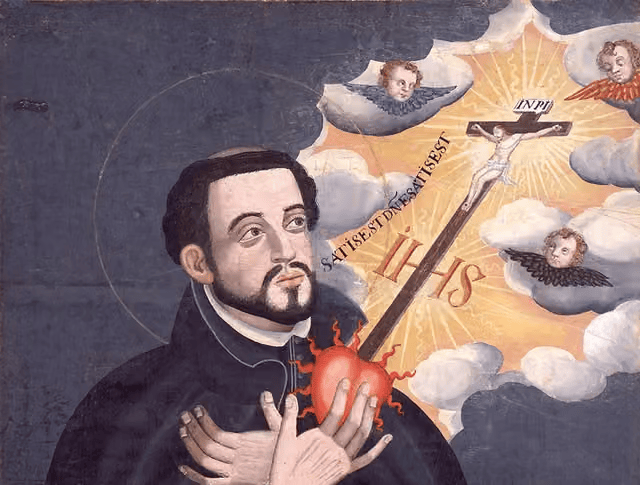
Illustration of Francis Xavier, the man credited with introducing Christianity to Japan, Credit: Wikipedia.
Kotaro Amon, The Sanctimonious Antagonist:
This long and storied history comes to a head in the form of Amon, who represents the catholic faith throughout the story. From his introduction in chapter ten of Tokyo Ghoul to the end of the original series, he is constantly depicted wearing a cross. His faith is strong; one might even call it foolhardy in the face of his past betrayals, and his rigid morality is stronger. Unlike the prevalent religions of Japan, Christians believe intrinsically in moral absolutism. Unlike the kami, who embody both negative and positive qualities, the Abrahamic God is infallible: “Sanctify them by the truth; your word is truth.” (John 17:17). In similar light, Amon holds the view that ghouls are absolutely evil, that “This world is wrong… and it’s you monsters [ghouls] that are distorting it!” (Tokyo Ghoul, Chapter 24). Throughout the series, Amon holds the most ‘just’ beliefs around the extermination of ghouls. Where other characters see the CCG as a career path, or a way to get fame, or are simply battle-lusting maniacs, Amon genuinely holds the belief that ghouls are the root of the world’s suffering, and thus wiping them out with minimal suffering is the only reasonable solution. This is naturally a fallacious belief born of his childhood trauma, which ignores the suffering humans inflict on each other. Nevertheless, Amon’s absolutist views constantly clash with Kaneki’s attempts to live a decent life with his new flesh-eating urges, as he continues to try to hunt Kaneki and his friends down throughout the series. His Christian morality result in him inflicting significantly more suffering than he alleviates, destroying families, breaking hearts, and being an all-around antagonistic figure.
Shattering faith and personal growth:
Thus, it comes as no surprise that Amon undergoes a beautiful redemption arc in Tokyo Ghoul:re. Forced to become a ghoul himself, he must now suffer under the same affliction that he held ghouls in contempt for since childhood. He begins to question himself, realise the fallibility in his beliefs, the humanity present in ghouls and the inhumanity present in humans, that holding onto absolute morals is idiotic: “Keep asking yourself if you’re making the correct choices… that will always be right.” (Tokyo Ghoul:re, chapter 98). This is symbolic of the breaking of his faith, the moral absolutism innate to Christianity leaving him. However, the deep roots of his moralism are still present in his talk of sin earlier, and the fact that he still holds ghoul investigators in higher regard than ghouls, telling Takizawa, “You’re not a ghoul, you’re a ghoul investigator” (Tokyo Ghoul:re, chapter 90). He holds a strong sense of self-loathing for his ghoul aspect, which remains even at the end of his character arc. He acknowledges that he too “was distorting it [the world].” (Tokyo Ghoul:re, chapter 171) while stating that he still sees ghouls as evil.
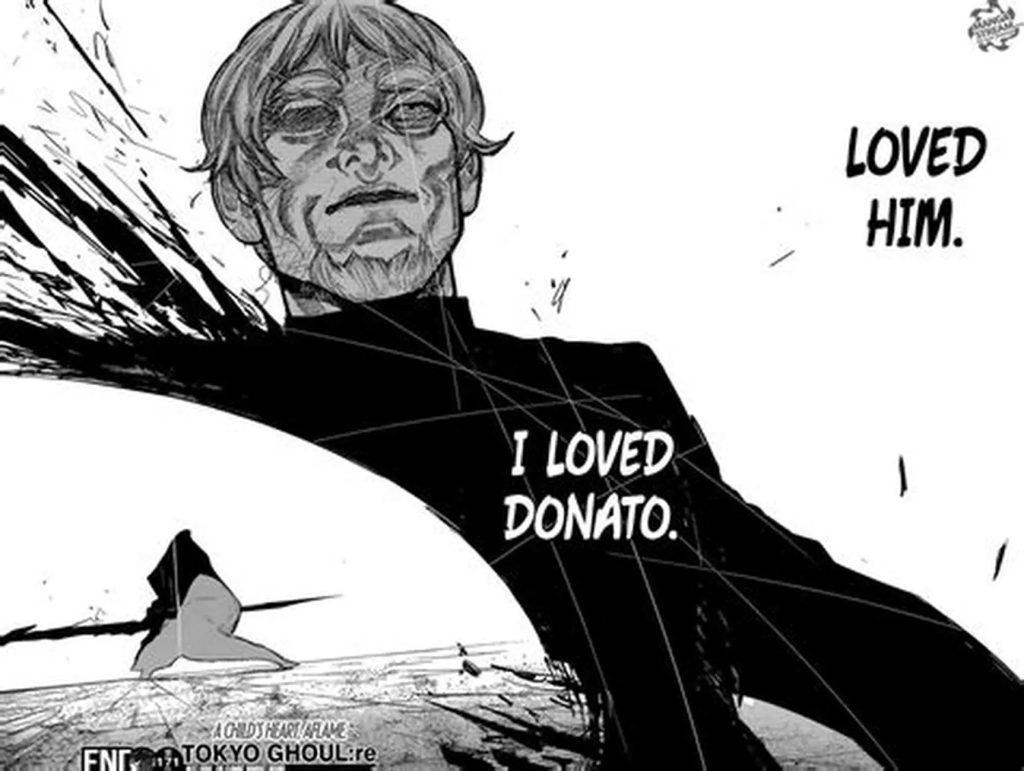
Credit: Tokyo Ghoul:re, chapter 171
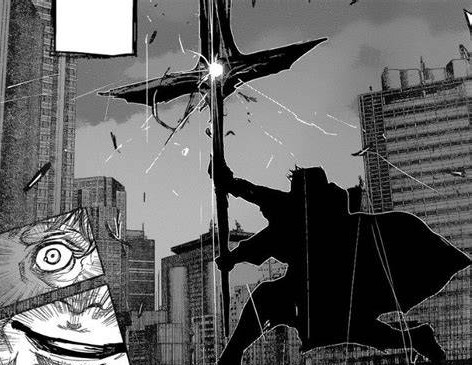
“What’s wrong with a son loving is father?” (Tokyo Ghoul:re, chapter 172) is the finale of Amon’s character arc. The ‘father’ carries the double meaning of representing his love for the evil Donato Porpora, and his desire to be closer to God, to justice, which he chooses to pursue despite his self-proclaimed unjust existence. He has grown past the self-righteousness apparent in Christianity, into a character that closer fits into the Japanese moral standard of more collectivist acceptance of sins and true forgiveness, whilst still retaining his faith, as is symbolised by him literally carrying his own cross in chapter 172 (see cover image)
Conclusion: the importance of cultural frameworks:
Many people across the world like to think critically about the works they consume, however, one of the greatest fallacies born of the modern era of ‘death of the author’ is to completely forego context and view every work from a western ethnocentric lens, morally, philosophically, and religiously. While this essay is not outstandingly deep or insightful, I hope it made fans of anime and manga, or any other foreign media, think more about the completely different frameworks that occupy the foreign creative’s writing. While in the west, Christian imagery is effectively unavoidable, influencing nearly every creation subconsciously due to its deep societal roots, in the east, it is a highly intentional choice to include such symbology as the cross. It is pivotal when analysing foreign media at any level to understand that foreign people grow up on completely different systems of belief, folklore and religion. In the way that King Arthur inspires much of British storytelling, Yamato Takeru inspires much of Japanese storytelling. Mistaking one’s reference for the other’s risks missing out on significant symbology and ideas. You should strive for a comprehensive understanding of a region’s history before you begin to critique its art.
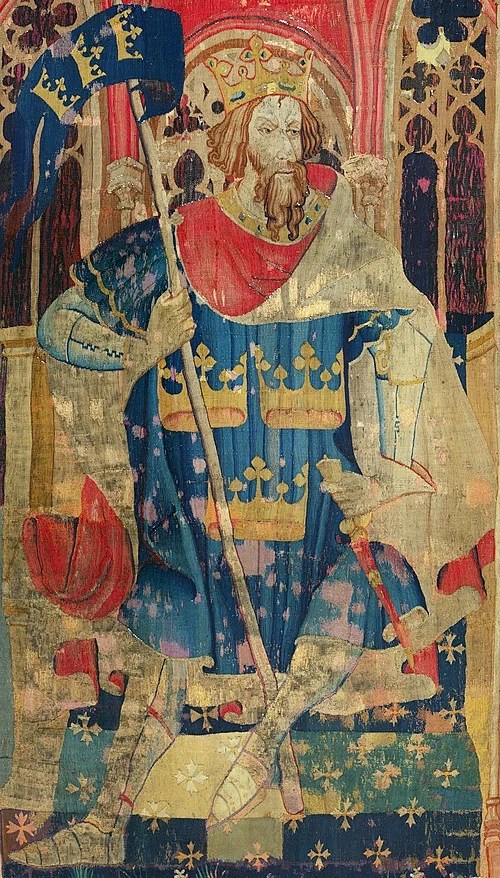
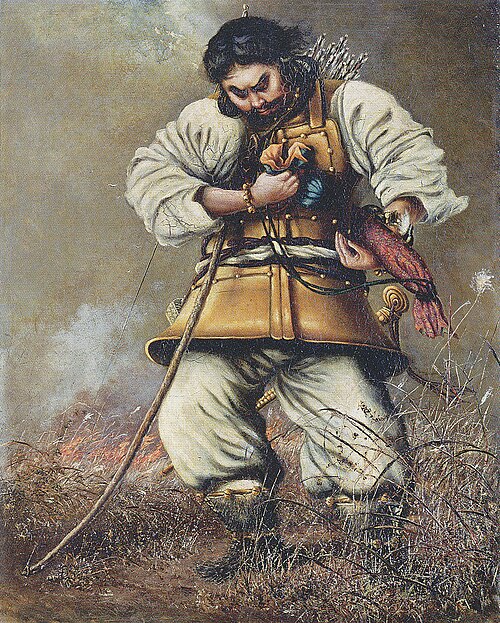
Images of King Arthur and Yamato Takeru, Credit: Wikipedia
References:
-Ishida, Sui (2011-2014) Tokyo Ghoul, Viz Media
-Ishida, Sui (2014-2018) Tokyo Ghoul:re, Viz Media
-(1978) The Bible, New International Version
-M., Max (2024) (Christianity in Japan: From 16th Century Origins to Modern Influence – Welcome). (accessed 18/10/2026)


Leave a Reply